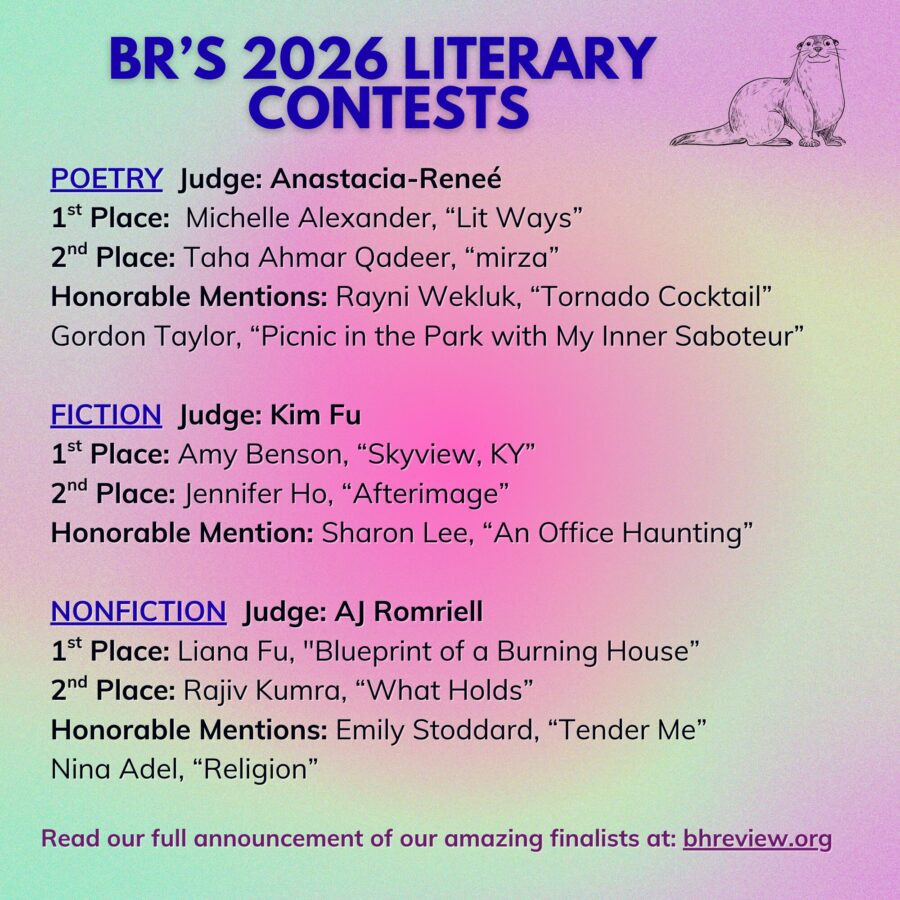
We are thrilled to announce our 2026 literary contest winners! We received 722 submissions this round (!) and we loved reading your pieces. Congrats to all our finalists! The first place winner of each contest will receive $1,000. The second place winner of each contest will receive $500. Look out for their award-winning poems, essays, and stories in Issue 93!
Poetry (49th Parallel Award, judged by Anastacia-Reneé):
1st Place Winner:
Michelle Alexander, “Lit Ways”
"In my neck / holding / this asphalt / terror / is a star / Line." This heavy circle of words dangling there in the middle of the poem, not waiting for permission from the reader but inviting them as a witness—I love the way this poem's format and structure give way to a body of words that embody a road. A sky. Liberation. Pain. As a reader the ending is flashing-neon and true: "America / When service is a station, pump the brake."
2nd Place Winner:
Taha Ahmar Qadeer, “mirza”
I thoroughly enjoy "mirza"’s experimental function of “lude’s.” I am excited about this poem for its structure, brevity, and intentional expansive literary bandwidth. “So what” becomes… so it did. “a war-drobe / to find / no water / in the well / just a tree / Dressed / in red”
Honorable Mentions:
Rayni Wekluk, “Tornado Cocktail” Gordon Taylor, “Picnic in the Park with My Inner Saboteur”
Finalists:
Margaret Reges, “The goat’s eye was a clear star…” Sloan Asakura, “梅 for plum 運命 for fate” Janice Lobo Sapigao, “On Fridays” Micah Dela Cueva, “Dead Bodies are Simply Numbers to the Living” Indrani Sengupta, “monomyth” Phantasia Yu, “Sonnet for Manila” Erin Stoodley, “My Favorite Hands”
Nonfiction (Annie Dillard Award, judged by AJ Romriell):
1st Place Winner:
Liana Fu, "Blueprint of a Burning House"
"Blueprint of a Burning House" is an extraordinary work of lyric nonfiction that excavates deep truths with both rigor and tenderness. In a narrative collage of transcripts, photographs, art, interviews, questions, answers, and memories, the essay moves seamlessly between archive, experience, and speculation. There is a grounded understanding here that history, perhaps especially family history, is often composed as much of absence as it is with presence, and the author approaches that complexity with remarkable intelligence, curiosity, and grace. The result is a truly urgent, deeply human, and formally inventive piece that lingers long after its final pages.
2nd Place Winner:
Rajiv Kumra, “What Holds”
Structured around ten carefully chosen words, "What Holds" traces the fragile but enduring threads of family history, cultural memory, and belonging. Through reflections on food, family, displacement, loss, and more, each section deepens the reader's understanding of the profound ways language can hold all that history constantly threatens to erase. “What Holds” is a work of profound intelligence and compassion, reminding us that preservation often begins with attention to the ordinary—a recipe, a place’s name, a family story, or even just a bay leaf.
Written as a chorus, the population of a flooded and relocated town speaking as one, individuating as though coming up for air, “Skyview” demonstrates a stunning command of language and voice from start to finish. Each paragraph is flush with the kind of strange, intimate, urgent details and turns of phrase that feel true, the terrifying surreality of reality, of disaster and bureaucracy, of surviving another day.
2nd Place Winner:
Jennifer Ho, “Afterimage”
The mother haunting this story is unforgettable—defiant and sharp, drawn with ferocious, cliché-defying specificity. I felt moved by her son’s palpable longing to know her better, even as she remains stubbornly present after death. Appropriate to the title, images of her ghost—occluding the California sunset, falling through the bottom of a car in surprise, her eyelashes like curled lemon leaves—stayed with me long after reading.
Honorable Mention:
Sharon Lee, “An Office Haunting”
Finalists:
Maximilliani V. Pierce, “BLACK and WHITE and RED”
Marie Holmes, “La Patriota”
Rajiv Kumra, “The Ash We Carry”
Sarp Sezsinler, “Wound Paints”