Fledge
In the late 1800s, there were over one hundred thousand nesting pairs of American bald eagles. By 1970, there were only four hundred nesting pairs. In 1978, eagles were put on the endangered species list. In 2007, they were removed. Sometimes, we know how to fix things.
In 2019, a pair of bald eagles made a nest in our back poplar tree. I have read that they spend most of their fall and winter in the delta flats before heading upriver in the warmer months. Eagles have strong nest site fidelity. I have read this in a book somewhere too. My husband and I have been tethered to our home and small farm for the past decade, even more so now with small children.
Fierce hunters, eagles take what they need when they need it. We find a devoured Mallard carcass in the back field, a scattering of chicken feathers in the lawn, mostly likely from the neighbor’s flock. Dressed in leaves, we only heard screeches and squabbles from that tree throughout the end of the summer. By fall, the enormity of their nest was clearly visible in the naked cleft of trunk. Eagles’ nests are five to nine feet in diameter and they add to their nests every year, a branch or raft of rabbit fur. The depth of the nest can reach up to eight feet.
*
“Where do days live?”
My three-year-old daughter asks me this while lying beside me in our bed.
“Good question, Eloise,” I mumble from my disrupted slumber.
“Can we go downstairs?” she sings.
“Use your whisper voice, sweetie. Your sister and Dad are still sleeping.”
I want to keep sleeping too, there is still half an hour of precious rest time until my alarm goes off. She must have crawled into our bed at some point during the night. Eloise starts singing a song under her breath. She is observing and thinking, constantly.
“Why are breakfast foods different from dinner foods?”
“Hmm, I don’t know the answer to that one,” I say from deep within the den I’ve created under our flannel duvet. It is winter, and the sun is still far down below the Cascades, yet there is a graying glow.
“Can we go have cereal now?”
“Are you hungry, Lulu?”
We have come up with many names for her. Lulu, oui oui, the wiz, E-Lo (her middle name is Loran after her grandfather and great grandfather) and also weasel—from the period when she was constantly stealing little things, like a crucial game piece or a magnet, and either shoving them into the couch cushions or dropping them down the furnace vent.
My older daughter doesn’t have a true nickname, besides the occasional Junie or Juno, but I like to use her middle name when I address her: June Helen. Helen was the name of my grandmother and great grandmother, women who are no longer with us, but still occupy a fiery place in my heart. My husband and I agreed on the name June, but I wanted to give her the option of coming into her full helenness in the future. The kind of woman who makes her own sausage and takes hot air balloon rides at age eighty.
“Yes, Mommy, I want cereal!”
Eloise isn’t using her whisper voice.
I open my eyes. She is now sitting straight up in bed, wide awake, her raptor eyes round, shifting, ever alert. Using both hands, I reluctantly push myself up and give her a hug and a kiss on the head.
“Let’s go weasel.”
“Yay!” she exclaims as she leaps off the bed and races out in front of me.
*
Bald eagles mate for life with parents taking turns staying with the young in the nest while the other brings prey home to feed the nestlings. My husband and I make good co-parents; when I am removed, he is nurturing, when he is forgetful, I have the memory of an elephant. We both cook and clean, him more so. We are leading each other into the unknowns of parenting, neither of us really knowing if we are doing it right. Both male and female eagles tear food into small pieces and feed it directly to the eagle chicks. The age of first flight is about ten weeks. When considering bald eagles have a life span of twenty years, the readiness of their young to enter the world surpasses most wobbly toddlers, unable to walk or feed themselves until around ten months.
*
Like many during lock-down, I started to watch wildlife more intently and it was hard to avoid anthropomorphizing the eagles. When the pair was sitting on opposing branches, I assumed they had a marital spat. I referred to their scavenging for dead voles—cut up by the neighbor’s rototiller—as a date night. With the eagles, I took a certain pleasure in watching the pair’s comings and goings. The routines of animals and plants, cycles and seasons, nourished me.
I also developed a mild fixation on Fiona, a young hippo at the Cincinnati Zoo. She was born prematurely. She often entertains visitors with her antics and expressions, her bulbous body looking effortless in water. I discover that there is an entire Facebook fan group dedicated to her and the zoo’s hippo family, her bloat. Even after things open up again, I continue to follow along online. I share photos of her eating and swimming with captions like, “Mood” and “That me.” People travel for hours to visit Fiona. A couple shared their engagement photos, taken in front of her tank, with the online group of strangers. Fiona’s draw is a wonder, yet I google how long it would take to drive from our farm to Cincinnati.
Another Facebook fan group, dedicated to the American White Pelicans of Padilla Bay, was started recently. When June was about two, I saw a flock of these pelicans off the Padilla Bay Shore Trail and wrote a poem about it. That was before the eagles made their nest. What are those pelicans doing here, I wondered? We are too far north for pelicans. Now, this group watches and reports on the resident pelicans—how many, their location and activity?
It turns out they keep coming back. And post-pandemic, everyone is a birder.
*
When the eagles’ young hatch, they will need food, care, and protection. We try to spot the eaglets, but the parents keep them well hidden. They will learn to fly by branching—learning to flap their wings by jumping to a branch adjacent to the nest. When we walk out to the mailbox, I remind the girls to stay behind the white line, keep away from the road. I remind them again, and again.
June has developed her own eagle call. It is loud and shrill. She sprints, stopping to rise up on her ballerina toes and spread her long arms, like her father’s. She opens her mouth to the wind and there is a short silence before the pair responds.
“June, they are talking to you,” I say.
“I know, Mom,” she quips.
Time echoes in my ear like bird song, like eagle screech.
*
There is a sliver of light between us. Eloise dabs purple paint onto the paper. The cat, perched at the far end of the table, lifts a leg and licks rhythmically. The sunshine is a pleasant break from the rain and wind and the yard is drenched in an unusual yellow ochre glow.
When the painting is done, we bundle up and head out to the swing. It’s fastened on an ornamental plum tree that produces no fruit in the summer, just dark purple leaves the color of eggplant. Now it’s an outline of itself. The presence of that nest, the returning of the eagles from their summering grounds upriver, offers me continuity. These children are changing so quickly, I have been changed by them. It is hard to keep track. The nest serves as a constant.
Eloise glides back and forth under the swift snap of my wrist. She delights in being off the ground and flying. I look up and our eagles are circling, watching. Perhaps I should herd the ducks, gleefully waddling in open grass, back to their protective run? They are, after all, fierce predators.
*
In a following summer, close to the time we expect the eagles to head up river again, my husband noticed a juvenile out in the back pasture. There’s a baby eagle back here, he texted me. I immediately thought, baby. I thought small. I shape my arms into a cradle, rocking back and forth, feeling the memory of my babes on my skin. That kind of small. I can’t wait to hold it.
As I made my way through the gate, I looked along the fence line and saw a massive creature with a sharp gaze and fresh, gleaming yellow bill that could tear my face off. It stood up tall, but there was something wrong. We crept in and it started to run, but never tried to fly. It looked lopsided, like it’s wing was broken. I called the local rescue group.
“Is the bird in distress?”
“It looks like it has a broken wing. Will you be able to come and get it?” I asked.
“We don’t have enough staff for that, but if you’d like to bring it up to us, we’ll definitely check it out. We recommend throwing a bed sheet over it and getting it into something like a dog crate.”
“Okay.”
I hung up the phone and told Dean the plan. He scuffed. I went to fetch a sheet and an old dog crate—the one we use to house new lambs abandoned, for various reasons, by their mothers. They are too small to be outside with the flock. Eagle bait.
We hunched down, circling our way around the eagle. I realize I should be wearing closed-toed shoes at this time, not Birkenstocks, but we were already in motion. We inched the dog crate closer. The eagle didn’t try to get away, but it did squawk a little out of what I supposed was fear. My husband, in his caring way, tried to round it up into the crate, but it was as still as a statue. At this moment, I was grateful for my years as a rugby player in college, followed by seasons of sheep wrangling. I threw the sheet over it and as he carried the crate in, I grabbed the eagle by the top curve of its wings, pushed the wings in toward the body, and shoved it in the crate. As he slammed the door, I pulled the sheet back like some sort of deranged magician. My adrenaline was spiking.
Looking at this creature, so stoic, so powerful, staring back at us through a dog crate was mesmerizing. Although just born in March, it seemed almost full size. This juvenile was fully brown in color, without a white head yet.
Dean pulled the minivan around and we put the crate in the back, making sure that it was latched and steady. With my daughter in her car seat, he took the eagle up to the rescue place. Eloise wanted to go and I needed to get June up from camp. He said that ride was pretty quiet. After a long silence, they could hear the eagle shuffling around in the back and Eloise giggled a little, “I forgot there was an eagle in here.”
The rescue place called us back later that night. The eagle’s wing had already been broken and had healed improperly—it was broken again. The juvenile also had lead poisoning. They had to put it down.
Eloise still asks about the eagle we saved and I still don’t have the heart to tell her the truth. It is up there somewhere.
*
On a cool, fall morning, I clutch my cup of coffee and watch as both girls cross the white line to get on the yellow school bus. Waving heartily, the bus floats into the valley’s low fog. There are many ways I can fill this time they are no longer with me, yet I pause.
When I turn back to the house one of the eagles is overhead, wings unfurled, flying into the wind. They will have new eggs to tend to this winter. New fledglings that will hopefully survive and make it. For a brief moment, its brown body and white head hovers over me, and I watch in awe.
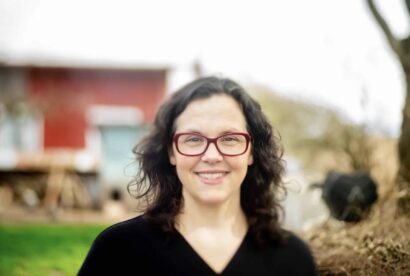
Jessica Gigot is a poet, farmer, and writing coach. She lives on a little sheep farm in the Skagit Valley. Her second book of poems, Feeding Hour, was a finalist for the 2021 Washington State Book Award. Jessica’s writing and reviews appear in several publications, such as Orion, Ecotone, Terrain.org, and Poetry Northwest. Her memoir, A Little Bit of Land, was published by Oregon State University Press in September 2022.