Endings
An auntie and an uncle are getting into an argument in front of the church doorway. One usher tries to steer them toward their car and away from the incoming crowds, and the other usher continues handing out the weekly bulletin. Claire has forgotten the names of the couple but recognizes them — they have organized the annual camping trip for the past ten years, at least. The auntie is nearly crying. Both of them keep interjecting their own remonstrations with apologies to the usher, but, the change of audience too hasty, those words come out angry and hostile as well, bullets misfired.
A small crowd is forming, jammed on the narrow sidewalk in front of the long, squat building. The non-intervening usher continues waving politely at the cars pulling up in the driveway, worming their way onwards to the parking lot. The friends of the couple try to comfort, console. Claire’s mother, Mrs. Liu, stares. “What’s with all this?” she wonders aloud. “It’s rude to ogle,” Claire says. “I’m not ogling,” her mother hisses, the word “ogling” accented by its non-Chineseness. “No one is ogling. I’m just concerned. Hold my arm.”
“Liu Ming, zao!” The usher calls, handing Claire’s mother a bulletin. “Zao,” she coos, nodding. “What’s going on over there?” she asks, lowering her voice.
“Don’t worry about it,” he says genially, holding the door open.
Clusters of three to four people mill around the low-ceilinged, carpeted lobby before service begins, currents of Cantonese, Taiwanese-accented Mandarin, Beijing-accented Mandarin gusting and swirling. Children chase each other out of the lobby, into the linoleum gymnasium reserved for youth worship, back into the lobby. Claire imagines them falling in love easily, knowingly as she had. From a young age, it was made obvious to Claire that church was about, yes, singing, crafts, snacks, but most importantly it was about romance. The way Sunday encounters allowed anticipation and rumination to well up over the course of the week, the way all the young teachers in Sunday school were coupled with the people they had grown up with in the very same church, the way her family would certainly approve of a Chinese-American, Christian boy that they had practically raised as part of the proverbial village: it all had the alluring sensation of something that would work out. In this way, desire became inextricable from psychological comfort. Claire misses it sometimes: the certainty of having your life tangled up in itself, a single hairball to pull out of the drain instead of a million individual strands. Certainty, was, as her parents often reminded her, the essential thing her family had been struggling for all these years. Could she blame them?
On unsure and grey mornings, ever more common these days, Claire demurs about cutting church out of her life. She sometimes feels that you need to have at least one thing in your life that is something you have always had, otherwise you start to feel formless like flour, getting tossed through the air and into dissimilar configurations like breads or gravies. Another certainty of church — the reminder that you were once a little girl and that the little girl grew incrementally, building on herself, into a larger girl, rather than the more frightening alternative, that the little girl died some gruesome death and this strange large girl was born yesterday and has to start over again. The only way you can feel any truth in the former is by keeping some consistency: see, I did this when I was little and I still do this now that I am 19 and elderly, which means there is something essential about me and finally something that might last.
David’s father is the first to see Claire and her mother enter the lobby. “Your daughter’s back, is she?” he calls out. He tilts his head. “She’s pretty now!”
Claire frowns. Maybe she should have been more adamant about staying home today. She should have said it’s been a long semester, or that she needs to begin looking for summer internships. Perhaps a tiny snail crawled into her ear while she was sleeping at the beach over spring break and it’s now eating at the precise area of her brain that might make her industrious and employable someday and she needs to go to the emergency room now.
“Not at all, not at all!” Claire’s mother says. “Isn’t uncle so nice? Say thank you to uncle.”
“Thank you.”
“How is David?” Claire’s mother often basically forgets that David turned Claire down for the Sadie Hawkins dance sophomore year, the saga causing her such psychic torment that she became one of Nick Drake’s top Spotify listeners for the year. Claire wonders if she forgets, or if the woman that was sent to revolution-era re-education camps as a girl just has limits on how much concern she can have for things like “Sadie Hawkins” and “Nick Drake” and “Spotify.”
“All he does is game! Same old same old,” he sighs.
“He’s a boy! It’s understandable,” Claire’s mother assures.
“He’s smart,” he says, “but he’s missing that drive. He’s not like Minliang’s kid.” He’s talking about Jenna, who works at Apple and was apparently the one that told them to get rid of the button.
“Well, if that’s the bar, it’s over for all of us!”
David’s father laughs. “I suppose we shouldn’t complain about our kids. It’s all about mental health now.”
“Sure, sure,” Claire’s mother says. “Young people do have it harder these days. Right, Claire?”
“It’s trueee,” David’s father says before Claire can respond. “I’m not even sure David will be able to find a job next year. It’s harder for young men these days.” David goes to Harvard.
“It’s trueee,” Claire’s mother says. “But the Lord told us there would be persecution, didn’t He?” Claire’s arm limply hangs in the crook of her mother’s arm. She feels herself slouching, losing her sturdiness.
“Your daughter will have it easy. Girls do well.” His northern accent curls and gargles like a creek.
“We’ll see!”
When he floats away to another cluster, Claire’s mother leans close to her ear and murmurs, “You should reach out to David. His mom caught his dad in bed with their real estate agent.”
“I’m obviously not going to reach out to David.”
“Why not? Don’t be cold.”
“I’m not being —”
“This church means something to our family,” her mother says, re-clutching Claire’s arm. She sighs. “When Pastor Li loaned us money for our downpayment all those years ago — do you know how much that helped us? I practically learned English at this church. We owe it to our community to return that kindness.” She pauses. “I’m not even sure if you understand that these days — community. We really did work very hard to build that for you, as a value.”
Claire has heard this spiel in increasing frequency over the past couple of years. She knows her mother knows that she’s slipping, but she’s gotten away with not having to admit to it. How to explain that she just wants to fuck? That she doesn’t care if other people fuck? It really does just boil down to that sometimes, though it boils down to many other things as well, a jam made of fruits and sugars but also of cheeses and carrots and steak. For example — can she be a Christian that fucks? She knows that she theoretically can, but she doesn’t want to: the carrots and steak. She nods silently, which will be good enough to end the conversation.
“Claire!” Dr. Zhao is slightly startlingly tall and beautiful, wearing a pale yellow sweater and chiffon gray skirt. Her hair is tied up into a bun, loose black curls framing her face. “It’s so good to see you,” she says.
“It’s nice to see you,” Claire says, smiling politely.
“How was the semester? Did you ever end up getting in contact with Dr. Li?”
Claire’s mother is silent, which is how Claire knows she is ashamed. “It was good!” Claire says, and pauses. “Actually, I’ve dropped my major, so I never ended up reaching out.”
Dr. Zhao’s placid expression drops for a fraction of a second, just the zap of a fly against an electric paddle, before shifting into a more exaggerated pleasantry. “Oh! Are you still thinking somewhere in the sciences? Neuroscience, perhaps?”
“I’m not sure yet.”
Dr. Zhao nods. “Well, you’re such a smart girl. I’m sure you’ll end up just fine.”
Claire’s mother jumps in. “We are always so appreciative of auntie for helping Claire get that internship in the lab last year. She learned so much and it was so kind of auntie, wasn’t it?”
“Yes, thank you so much.” Her mother’s words seem to Claire a reminder, a nudge toward what she owes to others. Her mother loves to talk of the village, of neighbors that help each other meet their material concerns. This is what Chinese people understand that white people don’t. And yet, Claire feels a certain closedness, the acute feeling that she stands in a room. What’s wrong with a room? A room can have teacups, or the Mona Lisa, or a vault full of diamonds. She can’t think about this anymore. Moor, which is room backwards, woohoo. A village is good, yes, but which one?
If everything else — money, time, help building a table — can be exchanged and transferred rather freely here, can disappointment be as well? For example, if Ellie, the girl four years younger (four inches taller, four leagues more talented) than Claire, also takes up Dr. Zhao’s internship next year and goes on to become a Nobel winner rather than a young woman that googles “jobs no skills not defense contractor,” can Claire be forgotten? Will it be like Claire’s ambitions never existed? It would be a relief.
“What’s important is that Claire is happy. And healthy,” Dr. Zhao says. “I suppose it’s rarer than we think.”
“You think so?” Claire’s mother says, puzzled. People are doughy today, plush with well-meaning.
“It’s nearly 10 o’clock!” Mrs. Dao’s sing-song voice lilts over the intercom. “Please begin taking your seats.” Her son, Andrew, translates into English.
The nearly windowless sanctuary can seat about a hundred people. The red carpeted flooring rises in two steps on the opposite side of the doors, the pulpit sitting just right of center stage. The cushioned chairs are about half-filled as Claire and her mother follow the crowd inside. Lisa, a woman of about 30, sits at the piano on the left side of the congregation, going over the hymn order with Mrs. Dao. Claire finds Bonnie, clad in an Asian Christian Student Fellowship sweatshirt from the local state school, and they hug. “Where have you been?” Bonnie whispers. “We haven’t heard from you in so long.”
“I’ve just been busy!” Claire smiles. “I’ve missed you.”
“I’ve missed you too.”
Bonnie is breezy and cheerful — it always sounded far-fetched to Claire when Sunday school teachers said that if your personality was good enough people would wonder what made you so dazzling and you would get to say it was Jesus, but it has actually happened to Bonnie a few times. Claire can talk to her about school, TV shows, internet memes without feeling judged, though there is always the possibility that Bonnie will, taking advantage of a short silence, ask Claire what is really going on with her, you know, spiritually. Does she have a community? Best to avoid her after service, then, lest she has the idea to gather up the young people for a dessert run.
Mrs. Dao begins worship by saying that in these difficult times, people must gather in fellowship, must open their hearts and minds to the Lord’s wisdom. Claire wonders what “difficult times” Mrs. Dao has experienced lately, though with her it could be anything — affirmative action, trans people. Before Claire left for college, she took her out for lunch and told her four different times to never put her phone in her pocket because it could give her ovarian cancer. “The world these days is so out of order,” she says often. “I really believe Jesus is coming back in my lifetime. I know He is.”
Mrs. Dao makes double, triple sure that the congregation understands to only sing verses 1-3, then jump straight into 6. Out of the corner of her eye, Claire catches Ellie’s mother hastily walking in and taking a seat in the back. Ellie is probably at some volleyball meet or studying for one of her million AP exams, but Claire had been hoping to see her — you can almost convince yourself, when talking to a person younger than you, that you have learned something, anything at all in recent years: start out with sangrias before you try gin, study in the library and not your dorm, join a club even if you’re scared. It’s a boost to the ego just to say these things out loud, even if you know no one really needs to hear them.
Pastor Li and Andrew take the stage after worship and silent prayer. Their dynamic is evident before they even begin speaking: the pastor tall and portly, knocking the microphone about, the 24-year-old scrawny and bespectacled, shuffling and re-shuffling papers on the podium. Pastor Li is supposed to deliver a sentence or two, pause, allow Andrew to deliver an English translation, then proceed again. They’re always orderly for a while, but Pastor Li’s sentences eventually become rambling and unwieldy, and he finds himself, in fits of passion, interrupting Andrew before he can finish his translation. It doesn’t matter too much anyway — there are very few monolingual English speakers in the congregation, a stray white husband here and there. Poor Andrew, how we imagine Sisyphus and all. Andrew’s not faultless either — he stutters through his translations, peppering them with filler words. The congregation exclaims whenever he mistranslates a name or place: “It’s Judas! Not the Jews!” Sisyphus with an audience.
Claire isn’t sure why she even tries to pay attention — David’s little brother, Tommy, is sitting in the front row and has been playing Subway Surfers since the sermon began. There’s a politeness in her that she can’t kill, is not really sure she should kill. In any case, it might be good fodder she can take back to her friends in the fall. She’s the Chinese girl in her college friend group, whereas growing up everyone was a Chinese girl and so just a girl. She doesn’t mind, but with the label comes the expectation of good stories. She has the same expectation of her other friends — what do you do at Hebrew school? Did your family ever think about leaving Wisconsin? I thought Eid happened already? Pastor Li is talking about the moon today, how the eclipses were foreseen in the Bible and point to imminent societal collapse — good fodder. Claire passes the time by counting the number of specks in the carpet between her feet.
Her attention snaps back into focus at the phrase “young people” — Claire is in no position to be picky about guidance for “young people.”
“And the young people, they are in trouble,” Andrew says. So far so true! I am in trouble!
Pastor Li’s voice raises — his point is reaching a climactic moment. Claire stretches her lips. Uh-oh.
“Young people, uh, face all these troubles these days,” Andrew mumbles, “Uh, with their phones, their grades, and, uh, gay— uh, homosexuality.”
The congregation rumbles and amens in agreement.
“If you are a parent, and you are not centering Christ in your child’s life, you are allowing Satan in,” Pastor Li says, his voice expanding, stretching outward. “It is killing our children.”
Fewer amens. The rumbles turn more hushed, trickling with side conversations and shocked whispers.
“If you allow Satan’s distractions to enter your home, if you allow Satan to convince your child to rebel against the natural order of men and women, you condemn your child. You kill your child.”
The rumbles swell. People begin speaking at full volume to their neighbors. Andrew does not translate. Ellie’s mother stands up and leaves out of the side door. “Settle down, settle down,” Pastor Li says. He continues talking about the moon. Nobody can keep thinking about this anymore.
*
After the service, the congregation filters into the gymnasium for catered lunch from the Chinese restaurant down the street — pork and tofu stir-fry turned slimy in the aluminum steam trays. Claire and Bonnie sit in metal folding chairs at a long, white plastic table. They chitchat about life updates, Bonnie becoming more Christian by the day, Claire becoming more “busy.” Bonnie has recently met a boy that she’s gotten boba with, which means she might be engaged by next Christmas. Claire is at the end of her rope here. The morning has exhausted Claire, so much so that she’s not even interested in gossiping about whatever on earth is going on with these people today. After this, she will take a nap that will last six days, then she will get back on a plane to the other side of the country, where people are just getting to know her.
Claire works very hard to ramble, to not allow any silences to befall, but it can’t be helped. Bonnie waits just a moment. “What did you think of the message today?”
“A little overboard, as always,” Claire says diplomatically. “That’s just how Pastor Li is, though, I guess.”
“Not as always, though,” Bonnie says vaguely.
“He’s always into the moon, I think.”
“Not that,” Bonnie says, fidgeting with her chopstick wrapper. “Do you know?” Her eyebrows are knitted with concern, her eyes darting around and landing on the ceiling.
“Know what?”
Bonnie puffs her cheeks and exhales. “Claire, Ellie died.”
“Died? Where did she go?”
Bonnie pauses, watches realization explode onto Claire’s face. “Her mom found her in her room two weeks ago, with… pills, or something.”
Ellie might be at the table over. This would disprove Bonnie. Claire looks around. It doesn’t work. Should she try again?
“And Pastor Li said all of that today? You think it was about Ellie?” Claire mutters.
Bonnie doesn’t say anything.
“That’s so sad,” Claire says. She says it over and over again. There’s nothing more true in that moment. She doesn’t want to be kind or helpful or intelligent. She just wants it to be known — this burning orange comet of a tragedy. It is hot and boiling and giving her a fever. If she says it enough, and everyone sees how it can scald and combust, how can it ever happen? “That’s so sad.”
Claire passes by Ellie’s mother in the parking lot on the way out. The auntie and uncle are nearly pleading with her, reaching for her, re-reaching after she rejects them. They interrupt and re-interrupt her journey to her car with sorrowful, fraught apologies, but she has no grace for them today, her expression a scream of cloudy fury. “I told you she shouldn’t have come today,” the auntie hisses to her husband. “It’s too soon.”
The uncle ignores his wife. “It’s okay, jie jie,” he says to Ellie’s mother. So this uncle is Ellie’s uncle, though now he is no one’s uncle and is resigned to just be everyone’s uncle. “It’s not your fault.” Claire wonders what he means — not her fault that her daughter killed herself, or not her fault that her daughter was gay? The hairball in the drain.
*
In the Safeway after service, Claire watches her mother inspect an avocado. She cradles it in her palm and squeezes her thumb and index finger together. She rubs at a light brown spot to see if it will go away. An elderly couple argue about onions next to them. The lights in the store are blinding, the Safeway must be on fire.
“Did you talk with Bonnie today?” her mother asks, not looking up from the avocado.
“Yeah, I did.”
“How is she doing?” She drops the avocado back onto the display and pushes the shopping cart toward the bread aisle.
“She’s doing well, I think. She sort of has a boyfriend.”
“So nice,” Claire’s mother says absentmindedly. “You should make some time to see all those kids while you’re back. You can join their Bible study over Zoom, you know.”
White noise fills Claire’s ears. It settles in front of her face, she can almost see the tiny squiggles of haze that swallow her. The haze is of her and not of her, breath from her lungs and fumes in the air. She barely registers the trainwreck that has been her heartbeat for the better part of an hour.
“I don’t think I can go back there.”
Claire’s mother stares at the breads. “What am I looking for here?”
“I thought you wanted peanut butter.”
“Oh, right.” She picks out a jar a few feet down. “Low sodium,” she reads aloud. “Good.”
They peruse the jams to see if there are any interesting flavors. Claire’s mother had a new pomegranate jam from Safeway last week, it was very interesting, Claire should try it.
“It seems like these days,” her mother begins again suddenly, “you all want to make a big deal of things. Something makes you sad and you give up on everything around it. You don’t want to see it through.”
“Mom, a teenager died.”
Her mother sighs, turning the shopping cart around the corner. “I know,” she says. “But it doesn’t have to consume you. You still have things you need to do.”
“Ellie could have been me.”
“You’re not gay.”
“What would you do if I were?”
Claire’s mother drops a pack of Sandies into the cart. “You won’t find anything like this. Everyone is looking for something like this, something that makes all this worth it. Some reward at the end of our lives. You won’t find it in your friends, or your job. This is the only thing that gives us what we need.”
*
The last time she goes back to the church she is dreaming. She stands in a doorway watching two girls named Layla and Dory on the jungle gym. They wear ornate Victorian gowns that billow to the floor and puff in every direction, like airbags in car crashes. They climb down the back of the jungle gym structure on a rope with big knots, run around to the front, climb up the slanted wooden slats, throw themselves across green monkey bars. They leap from the top of the monkey bars to the roof of the church 50 feet away and 100 feet up. They somersault down to the ground with bejeweled golden staffs like the Monkey King. Thick wood chips spray from the ground as they land with thuds and giggles. Layla says very matter-of-factly to Dory that she’s too fat to catch up to her. Dory wails, a sound like the comet, a sound like Claire in two weeks on the sticky floor of some mouse-infested row home. Someone will play a pop song from when she was ten years old, and Claire will sob. She will try to call the number of worlds she used to live in and no one will ever pick up. It doesn’t matter what she musters up in her creative writing classes, what her new friends tell her about getting old, what the philosophers say about the solidity of her conscience. She’ll try to recall what it all felt like, to get some morsel of it back, but will only have stories to go off of.
“Claire,” her mother calls from behind her. “It’s time to go.”
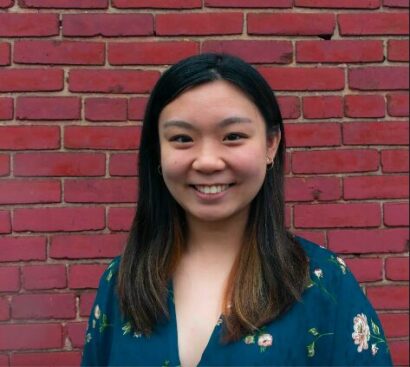
Victoria Chen graduated from Johns Hopkins University in 2021 with a Bachelor’s degree in biomedical engineering. She currently resides in Seattle, Washington. You can find additional writing from Victoria in The Forge Literary Magazine, Litbreak, and ARTWIFE.