Book Review: Mai-Linh Hong’s Continental Drift
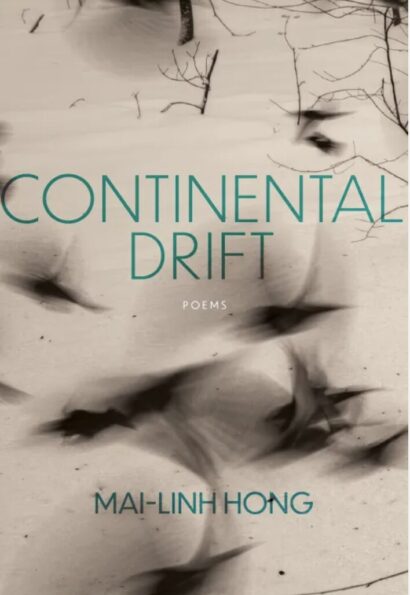
Shifting—singing—silting: the poems in Continental Drift form a landscape that cradles us all. Mai-Linh Hong’s debut collection (Trio House Press, 2026), winner of the 2025 Trio Award, shows extraordinary tenderness as it imagines pasts, presents, and futures of its subjects. War refugees and forced migrants board boats and find new shores, asking, “Can you say what caused us to go // in the first place?” (“Blue Ridge Elegy”). Family—cousins, aunts, grandmothers and grandfathers—gathers lovingly around us. Mothers sew, mourn, and promise to tend to their children “with the earth ablaze” (“Harvest Moon with Wildfire”). This book pays keen attention to the world around it and those who are most harmed by oppression, its sense of nurturing almost instinctual.
Hong’s poems are as empathetic as they are insistent—or, perhaps, that’s the key: those two qualities are fiercely intertwined. To resist the forces of empire is to be deeply empathetic—to the migrant, to the refugee; to mourning mother whales and hungry children; to the martyr, to the Earth. More than writing to an audience, Hong folds us all in. Everybody’s a cousin—in a truer sense than you would think, with a poem titled “Everybody Cousin.” And to these various people—to us, the readers—I imagine a hand reaching out from the words with caring, protection against violence. Care manifests through mentions of feeding one another: Plum jam. Turkey and provolone tortilla wraps. Hot broth. “Salt sweet acid / of nước mắm // and want” (“[untitled]”). Continental Drift nourishes.
Yet, it must also be noted that this collection doesn’t stop at feeding its reader. Continental Drift is also conscientious of the world in which it surfaces as Hong does not shy away from war, genocide, the pandemic, and climate crises. In “Noise Canceling Love Poem,” line breaks turn into sites of scrutiny where multiple meanings spawn:
“…& a new
shipment of bombs
was let through
to a land already brimming
with bombs & democracy
is still falling, still
failing under the weight
of a million sullen men—”
The line “with bombs & democracy” detonates with double meaning. In my readerly mind, I had no choice but to reckon with the United States’ active involvement in various global conflicts. Palestine. Iran. And in even more places—how the US, a nation that supposedly over-brims with so much democracy, cannot help but share its “freedom”, its arms, its awful spoils.
As I take in these poems, I am reminded that this terror is nothing new. There is a 2019 Q&A between poets Solmaz Sharif and Lena Khalaf Tuffaha I keep returning to. In referencing Sharif’s collection LOOK, Tuffaha mentions how “the ‘political’—for lack of a more creative term—intersects so deeply with the personal… you never get to be in one landscape and not the other.” Landscapes: Mai-Linh Hong’s writing does not just cover faultlines, forests, and bays; her poems tread bravely across the multitudinous terrains of emotion when trying to survive imperial threat.
Continental Drift constantly shifts between my hands and in my mind. My understanding of violence and empathy moves as I traverse from poem to poem, land to land. The result, however, is not disorienting; if anything, I find a renewed motivation to find my footing, to reach out to others to steady myself. In my conversation with Hong about her new book, the topic of movement and migration naturally comes up. We talk about how the viewpoint of migration as being an “exceptional” event is inaccurate, especially from a U.S. perspective. “Almost all peoples in the world have migrated at some point, and keep migrating, right?” Hong says. I nod. I’m following the path of her thinking; as an immigrant to this country, I know what she means when she speaks of nation-states constraining migration and enforcing borders. “And yet we just keep moving. Plants move. Animals move. The continents are moving; everything is moving.” She’s speaking brightly, with an animatedness that travels through Zoom, even. This particular stream of conversation started with a question on form, and with her following response, my knowing is reconfigured once more: “Some of the poems are doing this sort of dance on the page where they are maybe telling me…that they want to move as well.”
I will leave you with these lines in “Continental Drift [I make my son’s lunch while a woman on TV]” which remind us that, “We are drifting // toward a future not where we imagine / because while we migrate / continents do, too.” Now, I am thinking of how these poems, like plates of the Earth, slide and ripple. How their push and pull depends on one another. And more importantly, how they serve as harbors for boats, as landing grounds not unmoving beneath us, their motion urging us to care. These poems: refuge for us readers.
Continental Drift will be released July 1, 2026.
Hungry and haunting, Sam X Wong writes poems. Originally an island girl from Penang, Malaysia, she currently resides in Bellingham, WA where she is earning her MFA degree in Creative Writing. Her chapbook hyperphagia was a finalist for the Jubilat Makes A Chapbook Prize in 2017 adjudicated by Lynn Xu. Sam X is immensely chuffed to be serving as the Managing Editor of Bellingham Review.

Mai-Linh Hong‘s creative and scholarly writings explore the imaginative ways refugees interact with landscape, place, community, and each other. Her debut poetry collection, Continental Drift, won the 2025 Trio Award and will be published by Trio House Press in July 2026.