Elsewhere
For three days we existed Elsewhere. A gap in the universe opened up and sucked us in, to another plane, another dimension, a new milky way made with brighter stars splashed like dairy on a black sky.
Everything was heightened in Elsewhere. Colors more saturated, sounds crisper and cleaner, smells somehow more precise. Taste and touch grew nerve endings that tingled and tickled. It all lasted longer. When we hugged our bodies lingered. We reached deeper. We offered more. More. Elsewhere was defined by more.
For three days we lived with more. Sunshine scorched us with heat, beating and glittering. It was so hot. 90 degrees. 95. 97. When it rained, it rained without relent. Thunder imploded our new universe’s sky. Lightening cracked us open. Our dog, Scruffy, shook and panted. Her tongue grew so long that it dragged across the floor.
On our first day in Elsewhere my mom stood in a black silk top and told a room of 400 people about more. “She was always ready for more.” She read from a printed sheet of white paper. “Let’s ride further, stay longer, do more.” My mom’s voice was steady as she spoke of my mama. “She pushed me to grow and be more.” The past tense made her words sound jagged.
400 people. Imagine the more-ness of 400 people. On our first day in Elsewhere, I stood, also in black, before that same room of 400. My hands and arms and legs and lips shook. I held onto my sister. We read from our printed sheets of white paper. The room trembled with us.
My mama died and we moved to Elsewhere. A magical, mixed landscape. A memorial service. 400 people. A shiva. Three days. All of it, more. More, like my mama, who taught us to be more.
In Elsewhere, I fell in love. Ten pounds of sugar in a five pound bag love. Love that spilled and scattered itself across this new universe. It padded our edges. Everything was softer and more solid at the same time.
I fell in love with my family. I’ve always loved them, but this was different. We sang Patti Smith and Led Zeppelin songs on the floor of my mama’s final day. We gathered like a holiday. We ate key lime pie and we laughed at raunchy jokes. We laid our feet across each others’ laps, drank tea out of ceramic mugs, took a photo with self-timer, the phone balanced on the mantel of the fireplace that was on even though it was June. After she died, we sat around the dining room table, which is something that you do even after someone dies. We ate babka and a plate of chocolate chip cookies for dinner. My cousin drew the scene, sketched it out in pencil on white paper, the image of all of our hands, reaching. That’s another way to describe what Elsewhere was like, a series of images worth trying to draw or write down. Before we walked into the room of 400, we stood together, circled close. We said our version of a prayer.
I fell in love with Loren. Again, different, somehow deeper, more. He played Stairway to Heaven over and over on his acoustic guitar. He gave us all melody. His fingers practiced until they moved on their own accord, all intuition, a knowing. His body, too, knew where to be, knew how to be there. He sat on the corner of my mama’s bed on her last morning alive. He reached for her hand, which was the oldest it would ever be. He read to her from his phone. When I picture him writing, typing out the note he’d use to tell my mama that he loved me, that he would love me, that we would be ok, it’s like I’m floating and falling at the same time. That’s possible here, in Elsewhere. Loren too, stood before the room of 400, dressed in black. He played Stairway to Heaven, the lyrics like a bird skimming the water above his notes.
I fell in love with my friends. I didn’t know I could fall in love this hard. They walked and drove and flew to me. They brought Hanes XL white t-shirts, boxes of tie dye, cartons of fresh fruit. How did they know this was exactly the right thing to bring? They surrounded me in color. We wrapped rubber bands around fabric, dipped white cotton into yellow and blue and pink. They made a group chat and named it “Jessie’s marshmallow pit.” Every day for three days, they sat with me on the back porch. They really did form a pit beneath me, a layer that was pillowy and soft and didn’t have any holes. Old friends and new friends, friends from every walk of the other universe’s life, they braided themselves together. At the memorial service, I could feel them more than see them. 400 people loving me back.
In Elsewhere, my love was more. My mama’s love was always like that, so big it was spilling out of things. This made me feel close to her. Like she was in my ear, just behind my shoulder, standing in the other room at the shiva making someone laugh. Only my mama could bring this many people together, could make a room feel this full and rich. I didn’t have to miss her too hard because she was so vibrationally present. I loved this about Elsewhere. It made me never want to leave.
In Elsewhere, too, my pain made sense. A room of 400 people, everyone in black. I shook before them. Tents erected in our backyard made space for mourners and bodies hid from the rain and sun, huddled close inside our loss. Our whole family wore torn black ribbons across our chests. They were meant to signify our hearts, torn open. Our pain was physical, our ribbons were proof.
Everything was acceptable, in elsewhere. We could scream until our throats lost their coating and our voices fell hoarse. We could refuse to get out of our beds. There was no expectation that we ever text anyone back. How do I explain that this meant I didn’t feel like screaming, that in the mornings when I opened my eyes, I felt capable of standing and rising from bed, that every single person who texted to tell me that they were sorry touched me in a new way, and I responded to each of them the same day. Elsewhere was free of expectations. We were free.
By definition, we could not live there forever. Elsewhere was an aberration. A brief slip into another dimension that would eventually spit us back out to planet Earth. On the last day of shiva, I dreaded our departure from Elsewhere with a physical weightiness, like I was attempting to secure myself to its temporary ground. My limbs were heavy. My eyes sunk into their sockets as if they’d been pinned down. I didn’t want the tents erected in our backyard to be folded back into their polyester pouches, for the yard to look so normal, so exposed. I didn’t want our dining room table, which we’d turned sideways, pressed up against a wall of windows, then stacked high with sandwiches that sounded vaguely Jewish to be cleared, returned to its home in the center of the room. I didn’t want all the people to leave. I didn’t want anyone to go.
They left. We left. I mourned this loss with fresh pain. I was desperate for a memorial service and a shiva, a ritual to mourn Elsewhere itself. Instead, days began to pass. Elsewhere grew dimmer. It was like looking at something magic through a rearview mirror in a car that can’t drive in reverse. I squinted, Elsewhere got smaller. The more of Elsewhere got harder to see. My mama was back there. Growing dimmer, smaller, further away. She’d built a whole universe for us. I hated having to leave.
In the first days after we departed from Elsewhere, I spent my mornings attempting furiously to write it all down. I sat at the counter of an Italian bakery near my childhood home, my laptop open in front of me, my skin raw with grief. I must have looked shocked, eyes wide, jet lagged from universe hopping. We never stop to think about whether the girl at her laptop in the Italian bakery is doing the first thing she’s done since returning to this world. We never stop to wonder if the person seated next to us on the subway lost her mama last week. I think we assume tragedy will wrap things in its web. Obscure them from view. And it will. It does. But then the web dissolves, and we’re still right here.
I wanted to write it all down. Every detail I could remember from our time in Elsewhere. The color of the hot fudge, dark and glistening, that we drizzled over vanilla ice cream, dotted with rainbow sprinkles and then coated in homemade whipped cream. The way the chocolate froze upon contact. How its sweetness cracked against my tongue. The middle school friend I hadn’t seen in a decade, whose smell was as familiar as her phone number, which came to me in full and reminded me of the phrase “by heart.” I pressed myself against her hair and the temperature in the room changed. It was no longer a room of 400 but a room of individual people who had known every version of who I was. The insurance broker, who my mama used to call each time my sister crashed the car, which happened pretty often; my sister’s a really bad driver. It became a running joke, Pat, the insurance broker. We gotta call Pat, again. We were always calling Pat about the car. I’d never met her before. And then she found me, on the first day of shiva. She wrapped her arms around me. She whispered, “Your mama changed my life.”
I wrote and I tried to tether myself to more and to my mama and to the sensation of knowing so crisply what mattered, as it seemed I did when we lived briefly in Elsewhere. It was like trying to hold smoke or sand. The tents came down. The table was turned. The house was mostly empty. It was harder for me to text back, to wake up in the morning, to get out of bed.
That life could return from the brink, could return from watching my mama end her own life, return from watching my mama drink four ounces of life ending medication mixed with two ounces of apple juice seemed to further erode the laws of physics. Our time in Elsewhere had felt responsive to the moment. My mama died; the universe shifted. This felt appropriate. The grandiosity felt right. She was gone, everything was different. Everything was more. And now, a shifting back. The receding of excess. It felt abhorrent. Offensive. Wrong. It should not return. We should not return. Life should not happen as it did before my mama died.
It happens anyway. A friend turns 30 and outside the web of Elsewhere I decide that I should attend his party, which will take place at his grandmother’s house on Long Island. Loren and I drive to the beach. We write song lyrics and hum made up melodies in the car. We are tender, newly reborn. When we arrive, people hug me like I’m breakable. They linger for a moment, then they show us to our room. Someone makes a cheese board with fig jam and brie, someone takes their shoes off, feet are dipped in the pool, there are people playing frisbee, wiping down counters, ordering burritos, which we’ll all eat for dinner, seated at a long wooden table later that night. If we were in Elsewhere still, these actions might feel like miracles, but here on Earth they throw me off-kilter, so normal they physically hurt. At dinner, I eat my black bean burrito and the voices of too many people talking about too many things that aren’t living or dying crowd together in my head and scrape across the innards of my scalp. I feel like I am drowning. We rarely stop to wonder if the burrito we are wrapping and then rolling in tin foil and then tagging with a sticker that says, “black bean,” will be eaten by a girl whose mama died last week. I stand up mid-dinner and leave to take a bath.
The next morning, we walk to the beach. I feel so far from Elsewhere. All I want to do is scream. This would no longer be acceptable, which I realize, and this makes me want to scream worse. My eyes aren’t blinking. The sun is landing at the wrong angle against my skin. On the road the gravel turns to sand. Beside me, friends. I want to crawl out of myself, out of this world, find the seam again, slip through it, fall into and then hide away in the other dimension, in the gap.
I see the ocean.
It really happens like that. Stark. Blue and grey and green. Rough and churning. White water rising like lips. I follow it, all the way, to the curve of the earth. It really happens like that. Lined in sunlight. I stare out at the ocean, this portal to elsewhere, this gap where land ends.
My mama and I spent a lot of time together in this ocean. My mama in her early thirties, blonde hair, blue eyes, big teeth. Me at two, three, four years old, salted little limbs wrapped around her neck. “Over or under?” she’d ask me. “Under!” I’d say and then I’d pinch two fingers around the outside of my nose, puff up my cheeks with breath. My mama would pull me tighter against her body. She’d say “ready?” She’d tug us under, together, under the water, under the wave. White water foaming around our heads. Up for air, we’d rise, beaming. “More!” I’d shout. “More! More! More!”
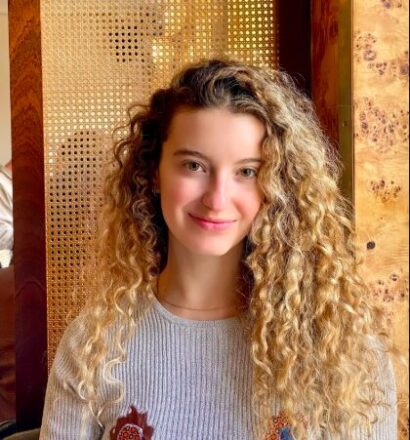
Jessica Petrow-Cohen is a Pushcart Prize-winning creative nonfiction writer and the winner of the 2024 Kenyon Review’s Short Nonfiction Contest judged by Melissa Febos. Her senate testimony on behalf of same-sex marriage was published in The New York Times and in former Senator Raymond Lesniak’s book, What’s Love Got To Do With It? Her writing has also appeared or is forthcoming in publications including The Kenyon Review, Brevity, The Washington Post, The Common, Fugue, Lumina, Working Artist Mag, and her Substack, “Claiming Writerhood.” Her work has been supported by The Virginia Center for Creative Arts, The Kenyon Review Writers Workshop, and The Vermont Studio Center.