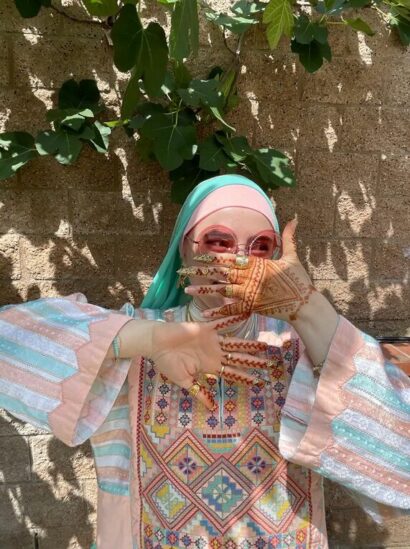
was a rope. A gold band, twisted
with smooth knobs. She, and my father,
and their mother,
and their neighbors,
and their village, left behind
orchards, the fruit & farm
animals, because the occupation
became close enough to taste.
Natural rope splinters
the tongue. Because they
remember it, unintentionally,
my body aches for it too. It’s not
luck, that I sit here, unknowing
and aware. Gold would taste
delicious. We go back
to trees. My father jokes
with his sister at dinner.
This is a funny story. Laugh.
They spent three weeks
watching cave walls
that protected them shake
spit dust every time a bomb dropped.
Eventually they got sick of it.
My aunt said her mom would
rather die on her land, than
the dirt hole they escaped to. What stupid
pride. The joke is this:
because they were gone
for so long, they found a feast
of chicken eggs and mallow.
“Only Palestinians eat grass and call
it a meal”—they had eggs a dozen
ways that day. We always go
back. We leave to return
and I think my father bought
an orange orchard in america
to go home to show us
that they’re worth dying for
even though he says we won’t ever
all travel in the same plane,
just in case one crashes. Someone must
live to return. I lost my aunt’s
ring, in an orchard. She left
it behind, we left
oranges behind, and I still
lost that ring, among fruit
that weren’t even ours.
Rema Ghassan Shbaita was acknowledged by The Atlanta Review as the Dan Veach Young Poet of 2019, does not consider dandelions weeds, and is allergic to grass. You can find some of Rema’s work in PacificREVIEW, the Mosaic Art & Lit Journal, with the Inlandia Institute, and in Heaven Looks Like Us: Palestinian Poetry distributed by Haymarket Books.