Given Names
The linguistics professor calls him “Pingüino,” but you don’t know why. Maybe it’s how he wears black cargo pants splotched in white paint. How he saunters into class late each morning with a perfect smile across his wide face. Maybe it’s his slow way of talking, and his eyes that are always looking farther than anything you could see, scanning the horizon. You are intrigued. This class is boring – a requirement in Spanish phonetics. You are twenty-seven, at least a few years older than the other students. It takes almost the whole semester for Pingüino to talk to you. It’s after you give your presentation on the interview with the married couple who speak Spanish with each other, the husband from Mexico, the wife from Ohio with a Costa Rican accent. You were interested in how the sounds of their Spanish adapted to the confines of their marriage. You think your presentation – where you stood in front of the class in a jean mini skirt, red sandals and a pink Puma tank top – probably made Pingüino notice you.
After class, he catches up to you in the courtyard between the library and the student union building. He asks if you are Native. Embarrassed that you already can’t be what he sees in you, you say what you always say to people trying to guess your origins: No, sorry, I’m half Filipino. Pingüino tells you he’s a mutt – part Mimbre, Taos, Chiracahua, Apache, and Italian. You like how he approaches you with ease, how he makes time to stop in the sun and introduce himself by asking you questions. You like how he already seems to embrace the you that you want to become. And you are so ready to fall into someone’s arms after a year of grad school out-of-state, living alone in a tiny apartment, falling asleep to no one on a too-hard futon every night. You’ve been so good until now.
Pingüino is the first person ever to send you a text message. It takes you a few days to notice the envelope icon on your flip phone, to know it means “message” and then to open it and find out he sent you something. It is to ask you how the orange tabby kitten is doing – the one your friend’s husband found in the passenger seat of his truck after a building fire. You named the kitten Little Champion and he opens your cupboards and eats your bread when you are away at class. Once you figure out how to reply (click each number button until it shows the letter you want), you and Pingüino have direct access to each other. You send words through white puffy clouds in a turquoise sky, his simple language always meaning more to you than he will know.
You learn he will be leaving in three weeks to study in Mexico. You think that’s too short of a time for anything major to happen, so you tell him you’d like to buy him a bon voyage drink at Marcus’ Martini Heaven. Across from each other, over waffle fries and chocolate martinis, you tell him you are married but your husband doesn’t live here. Pingüino narrows his eyes and looks at you like you’re a jewel in a dark mine. You leave the bar together and he walks you to your apartment fifteen minutes away. There is a municipal cemetery on the way, and you stop in the light of streetlamps to look at the crosses and faded plastic flowers over the waist-high cinder block wall. Or maybe this is the place where you tell him you are married, right before you kiss him, so he knows it can’t be serious. You want to show him how young and reckless you are. To you, the kiss is a poetic ending, like you’ve seen in movies. The kiss is a crown of flowers to grace what could never be. Pingüino will tell you months later that, to him, it was a bad omen to kiss in front of the dead.
For three weeks, you tell each other life is short. It is fall in New Mexico and the mountains are preparing for snow, wearing clouds like a hat. You and Pingüino move fast, fleeing rules, gathering each other’s histories, and closing eyes to your differences. He does not know if he will return to Albuquerque, saying there might be nothing for him here by winter. You do what you can between long rains and low moons. He memorizes the scars on your skin, and you record the structure of his bones in case winter passes without bringing him back. His crime is no more than yours. Your time together is a sore urging him to leave. For now, you take him into your cold home and pretend you are his food and water, nourishing. It is not enough to keep him.
His eyelashes and obscure gaze. His broad chest and strong hands. Your feeble and sunkissed arms. Your matching, long noses cast shadows. Silently to yourself, you change one letter in his real name so it can be “Toro” because he grunts like a bull when you get it on. But you still find love in that muted violence, no matter how succinct. You go back for more because he tells you you are gorgeous. He calls you endearing names like Kitten and Hon. He confesses he has a wall of bricks up. You want to be the one to bring it down.
You haven’t ever known anyone like Pingüino before. You are used to falling for the safe, loquacious type. There was the one from Intro to Sociology who loved you like a sister; the one who lingered outside the Arts & Music building who didn’t believe in tongue kissing; and the one who gave himself insulin shots after lying down with you.
As a teenager, Pingüino rode bulls and broke horses. Now he does motocross a few nights a week at the track down by the airport. He sold weed to pay for his plane ticket to Mexico. He wears his hurts well like the tattoo on his back that says Jesus is the Savior. You find yourself wanting to clean him up like a lost dog, and dreading the day you have to send him back to where he came from. You are from opposite worlds and you know there is nothing lasting that could come of that. You languish in the fresh memory of these autumn evenings that you think will be all you will ever have. Then you continue to try to be the wife you agreed to be. You tread softly on needles not knowing when you will be punctured.
*
After the luminarias around town went up and came down, and after having hid in your books for four months of biting cold, Pingüino returns from Mexico. You meet near campus for coffee and agree to be friends. You are still just as married as before, and he has fallen in love with a sweet Mexican girl who likes to tell him, I’ll smile for you if you smile for me. He goes north to his parents’ ranch near the Colorado border to help out for a while. Each twilight he calls you from their porch and tells you what the moon and stars are doing. He tells you about the horses he is breaking, how they do better in the round pen. Without corners they can’t stop, so defiance is their best defense. Afternoons he rides through mesquite, the height of his horse protecting him from thorns. He tells you to give him thirty days and he’ll be back in the city. He will come the slow way in his father’s Dodge Ram, engulfing the miles.
One weekend in spring Pingüino takes you up north where you sleep under an electric blanket in his childhood bedroom, now void of signs that he had ever grown up there. The house was built in the 1920s of cinder blocks, raised rapidly to shield the family from the dust kicked up by cattle and wind. When you and Pingüino arrive, his parents offer you homemade peach wine, then another drink “for the road” when you head to Folsom Falls. It’s so dark out once Pingüino parks the car – no city, star or moonlight – that you decide not to make the short hike to the falls. Instead, you sit in the car listening to ’60s music on the radio. His favorite song by the Association comes on, and he says you two would have been the perfect couple back then. You do not talk about now.
He drives you to a beat up, late ’50s Dodge Royal that was once his dream car, parked next to an abandoned house with grass growing up through the door seams. Then he shows you where Syd, his father figure, used to live in a trailer down the road. Syd had been a rodeo guy and taught Pingüino everything he knew. He told him never to believe that if something goes well in your life that it was luck. No, it was because you made it happen and you have to believe in yourself. Pingüino was fifteen when he found Syd the day he shot himself, brains all out of his skull.
The next day, Pingüino takes you to a ghost of a mining town across the state line where he had lived briefly as a teenager. There’s a chance of snow, so you get a room at a cheap motel and a bottle of Schnapps to warm up. He spills out more stories of people he loved and lost, reminiscing about pretty girls who came from backgrounds too close to his own and how it never would have worked with them. You do not speak of your own past loves. In this moment, you don’t even remember who they were. Somehow his recollection combined with your reticence led you to this place, and you make a kind of love that frightens and shakes you. As you move in your rhythm above him, your long hair swaying like laundry in the breeze, he tells you he feels like you are branding him, that he will only ever be yours. You’re out of your own body in this sunken bed of bleach-permeated sheets when he tells you he could be with you forever.
His stories, everything he says, captures and enlivens you. You forget any guilt you might have had about your insatiable infidelity, and you are sure this is where it ends. You are now finally with the person who ignites your dormant flame. He tells you he wants a family and a ranch, and you wonder whether you are tough enough to live that life there in the mountains. You consider it for him – not that he is asking you to, but you do. You would do anything to not have to let go.
*
In your last three weeks in Albuquerque, you do not see Pingüino. He’s not talking to you after what happened with your friends when you went out to celebrate graduation. That night you went to your first strip club trying to rouse your bad self before returning to your homely life in Seattle. You suddenly felt urgent about all you had yet to experience. You and your friends decided you should experience each other. You wanted something epic to make you real. That night, you cheated on your lover. You tell yourself it’s for the best that Pingüino is angry, because at least it solves the question of how things between you would end.
North of Santa Fe, at Storrie Lake, a state park popular with boaters and fishermen, halfway between where you first met and where he comes from, you told Pingüino what had happened the weekend before. But before that, he had told you he thought it would be cool – sexy, even – for you to explore with your friends, and you took that to mean your illicit relationship was boundaryless. Besides, you weren’t even really together. How could you be?
You don’t remember what you said, maybe it was just an uh-huh to his question of, So did you do it? and his slight smirk. Your tentative smile and nod. Then his silence and the way there was nothing to do but stare out over the lake. You were the only ones there. You wore baggy jeans, a fitted black and white striped t-shirt, your Italian leather boots that he loved. And just a few moments before, he had his arms around you from behind. The sweet lovers you were. But after you answered his question, his eyes got cold and vacant and he said, You better drive back to Albuquerque right now. You were confused and your stomach knotted up, and it was that familiar feeling of not being wanted or understood, judged before you could sort out in words what had caused you to do a thing that angered someone you loved.
It was that same moment when you were eight, dancing joyfully and then kicked over your mother’s porcelain vase by accident. Suddenly the world you knew turned against you. Your friend Marie – the first friend to come over to your house in the new town to which you and your family had recently moved – tattled on you when your mother came into the room demanding to know what had happened. Your mother pulled you by your hair and barked at you to clean up the mess, then stormed out of the room. To Marie, you choked out through tears that your mother was a “brat.” Marie said you shouldn’t call your mother names. You never invited Marie to your house again, ashamed that your unleashed pleasure for moving your body made you unlovable – despicable, really – to someone who had just moments before cooed and fawned in your direction.
*
You will not keep any proof of that spring in northern New Mexico. You will only remember Pingüino driving you around and showing you places that meant something to him as a kid. You will remember his pride, how puffed up he was, and how stupidly happy you were to be let into his world for a time. Then you will remember all the doors to your hope closing at once.
One year later, two years later, and again ten years later, Pingüino and you will meet without regard to the relationships you are each involved in. You will try each time to clean up your messes. You with expediency, he with trepidation. By then he will be a firefighter who disappears for days and weeks at a time, immersed in wildfires all over the west. When he texts you with photos of his ash-covered face and helmet, you will finally see how well he kept himself hidden from you.
When you google Storrie Lake State Park eighteen years later, there will be no story. There will be no explanation about how the water filled this mitten-shaped hole in northern New Mexico. On the state recreation website, one visitor will comment that there is only a puddle of water left with two geese and two crows splashing about. The rest is dirt. They see two people swim in the puddle and come out covered in mud. Another review posted three months later will note that the lake is “the fullest it’s been in over ten years due to the rain this spring.” The time you were there with Pingüino was also between a drought and a flood. You will wonder about how the water left and came back, all its quiet cycles churning through the histories of lovers who visited its shore, wanting to see beyond the brown earth that locked them in.
Storrie Lake has a surface area of approximately 1,100 acres, though the park area equals only 81 acres. This will puzzle you as you try to understand what the lake boundaries are exactly. Does the water that flows outside the park’s edges have the same name? You will think about Pingüino and how he extended beyond what you understood of yourself, of him, and of your time together. You were subsumed.
*
How it ends is that it doesn’t really. Because you carry memories like souvenirs, lining the shelves and walls of your interior to keep you company. As a child, your first souvenirs were from your mother: sweets, shells and fabrics that burst out of her suitcase as she unpacked from trips without you to the Philippines. She handed each item to you with indifference, as if it could be for anyone, but you held them all like they had your name on them. Early on, you learned about leaving and returning, and how to keep a little bit of every place. You know from numerous goodbyes that when you leave, to make it easier, you tell yourself you’ll be back.
As you prepare to return to Seattle from Albuquerque, you pack your belongings ceiling-high in your car, the way you had when you first set out for New Mexico. There is just enough room for you and your dad (who flew down from Seattle to help you move) in the front seats. After you have packed everything you can possibly squeeze in the car, you get a text from Pingüino that he’s standing outside your back door. You scan the apartment and spot some plastic hangers you’d planned to leave in the closet, and grab them mumbling to your father that you’re just going to step outside and throw those in the car as well. The sun is setting, turning the pavement and parched xeriscapes a dusky amethyst. You tell your father to go ahead and go to bed and rest for the long drive tomorrow.
Outside, Pingüino stands in the gravel between your door and the alley. He is there to forgive you or to apologize, but he does neither. You embrace, feel his fingertips linger on your shoulders when you pull away. You press consecration into each other’s hands. You aren’t sure if you feel lighter or heavier. You aren’t sure if you are saying goodbye or making a promise to return.
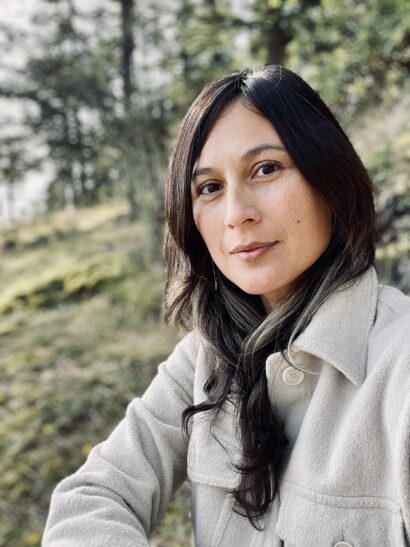
Elisabeth Vasquez Hein is a Filipina American writer and photographic artist based in Seattle, Washington. Influenced by her upbringing in disparate geographies, her work explores displacement, in-betweenness, and belonging. As the daughter of an immigrant, she seeks to understand her roots in the context of diaspora and colonization. She holds a certificate in Fine Art Photography from the Photographic Center Northwest, and a Master’s degree in Latin American Studies from the University of New Mexico. Her writing is featured in CRAFT and the Pinch.